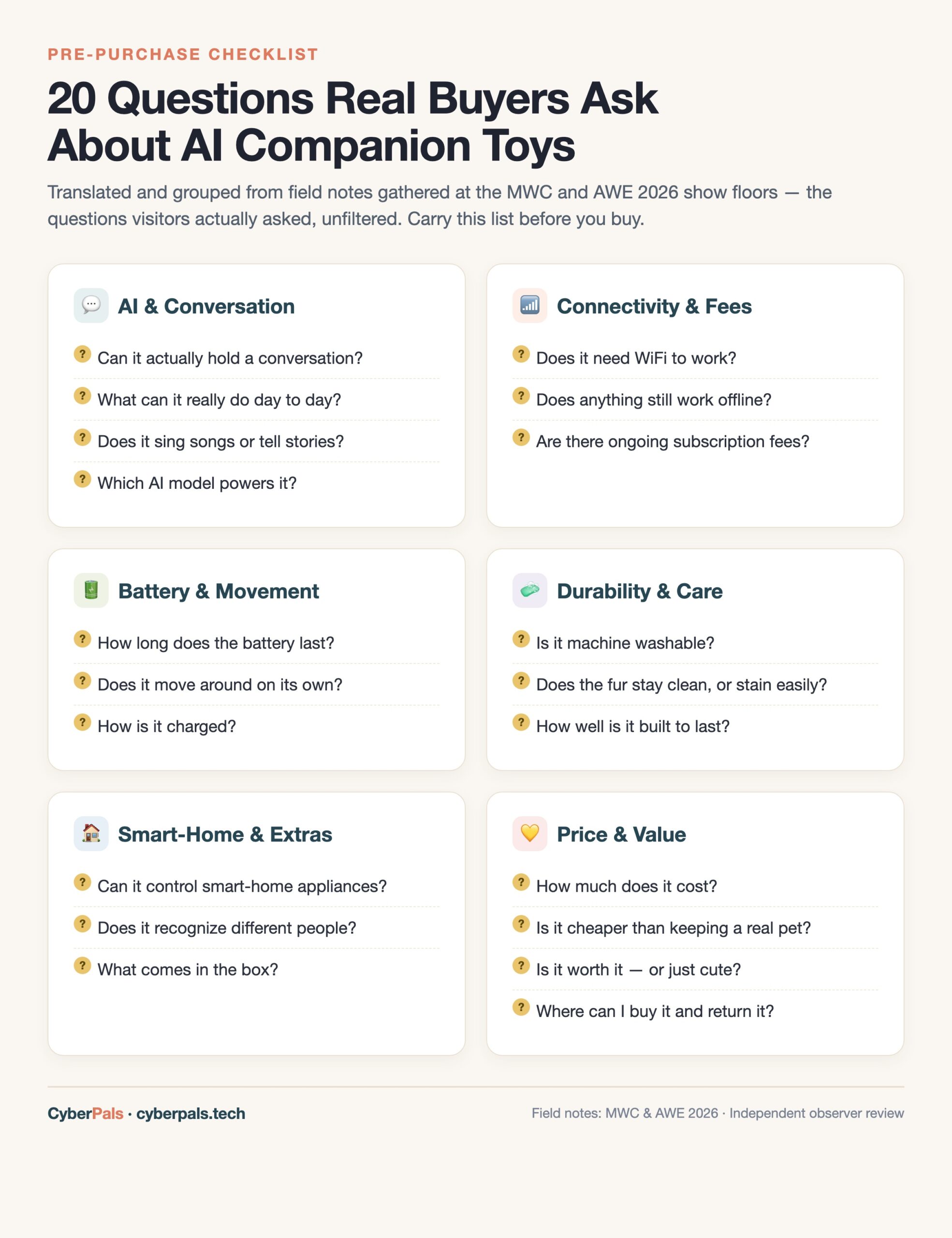
Originally reported by AI Toy Lab, a Chinese-language industry account run by a companion-robot product team, on Xiaohongshu, 2026-03-18. The team spent the spring working booths at MWC and AWE 2026 and published a field-notes infographic of the questions visitors actually asked them: unfiltered, repetitive, occasionally brutal. This brief translates that list, groups it, and turns it into the pre-purchase checklist we wish every first-time buyer carried into this category. Disclosure: CyberPals participates in the Ropet and Energize Lab (Eilik) affiliate programs, and purchases made through those links may earn us a commission. Our affiliate status never changes what we report.
This article is based on publicly available reporting, official brand communications, community feedback, and third-party reviews. CyberPals has not conducted hands-on testing of the products referenced below. All claims reflect manufacturer-stated specs or owner reports unless noted otherwise.
Why this matters
Booth staff hear the market before analysts do. When the same twenty questions come at you for four days straight (first in Barcelona, then in Shanghai), you are not looking at anecdotes anymore; you are looking at the demand structure of an entire category. The AI Toy Lab team did the industry a favor by writing those questions down instead of just surviving them.
For consumers, the list is even more useful in reverse. Every question on that show floor is something a real person needed to know before handing over money, which makes it a ready-made buyer’s checklist for a category that still has no Consumer Reports entry. That’s the gap CyberPals exists to fill, and this brief turns the raw list into one.
The four shoppers at every booth
The original post sorts booth visitors into four groups. We recognize all four from our own reader personas, and they map almost one-to-one.
| Booth visitor type (translated) | What they lead with | Closest CyberPals persona |
|---|---|---|
| The pragmatist: has a real problem to solve (child education, daily efficiency), needs the cost controlled | “I’m buying it to keep my daughter company.” | Sarah, 38: the parent buyer |
| The would-be founder: sizing up margins, tech stack, and market share before jumping in | “The parts cost is what, a few dollars?” / “How many have you sold?” | (Not a consumer; we don’t score for them) |
| The self-treat buyer: early adopter, cares about looks and features, not price-sensitive | “So cute. Cheaper than a cat. I want one.” | Maya, 27: the collector |
| The fence-sitter: drawn in by headlines, keeping tabs on the technology | “Does it actually talk? What’s the technical depth here?” | Marcus, 34: the curious skeptic |
One line in the original notes deserves its own mention: the team recorded that international visitors were consistently among the most enthusiastic at both shows. The companion-toy wave is not a single-market story, and the questions below are the same ones you should ask whether you buy in Shanghai, Berlin, or Austin.
The 20 questions, sorted into a checklist
Here is the translated question list, grouped by what each question is really asking, with the CARES+ dimension we score it under, so you can chase the answers in any of our reviews.
| # | Heard on the floor | What it’s really asking | CARES+ dimension |
|---|---|---|---|
| 1 | “Can it talk?” | Is there real conversation, or just sound effects? | C2: Conversation |
| 2 | “Can it sing? Tell stories?” | What does it do beyond talking? | C2 |
| 3 | “What features does it have?” | Where does the value actually live? | E: Expectation match |
| 4 | “How long does the battery last?” | Will it die mid-play? | R: Build quality |
| 5 | “Does it need the internet?” | Does it work offline, and what breaks without Wi-Fi? | A: Cloud dependence |
| 6 | “Which AI model is it running?” | Whose cloud is my child talking to? | A |
| 7 | “Are there ongoing fees?” | Is there a subscription hiding behind the sticker price? | A |
| 8 | “Can it control my smart home?” | Is it an assistant or a companion? | E |
| 9 | “How much is it?” | The eternal question. | E |
| 10 | “Isn’t that too expensive?” | What justifies the price over a plain plush? | E |
| 11 | “Cheaper than a cat, right?” | Total cost of companionship, honestly framed | E |
| 12 | “Can it move?” | Motion expectations: most plush companions can’t walk | E |
| 13 | “Is it washable?” | Can a fabric-and-electronics object survive real life? | R |
| 14 | “Does it stay clean?” | Same, from the parent angle | R |
| 15 | “When does it ship?” | Is this a product or a promise? | S: Support & aftercare |
| 16 | “How many have you sold?” | Is anyone actually living with this thing? | S |
| 17 | “An electronic Labubu?” | Collectible framing: is this a toy or a collectible line? | B: Bond & collectibility |
| 18 | “So cute!” / “I love it” | The emotional hook doing its job | C1: Emotional presence |
| 19 | “I’m buying it for my daughter” | Is it safe and appropriate for kids? | K: Kid safety |
| 20 | “Can you just give me one?” | (Booth staff endurance; no dimension covers this) | n/a |
Three things jump out of that table. First, conversation is the entry filter: “can it talk” was recorded as the single loudest question at both shows, which matches what we see in owner communities: it’s the first spec people check and the first one they regret not checking. Second, the money questions are really three different questions (price, price justification, and running costs), and vendors love answering only the first one. Third, washability shows up twice. Nobody who hasn’t owned a plush object asks that; everybody who has, does.
CyberPals Take #1 — The sleeper question is #7
“Are there ongoing fees?” is the most underrated question on the list. A companion toy’s sticker price is increasingly the down payment. Fuzozo’s richest personality features route through an app with a paid tier, as we noted in our Ropet vs Fuzozo comparison; several kids’ products bundle content subscriptions; and any cloud-connected companion carries an unpriced risk, the server bill its maker must keep paying. Before buying, get a written answer to three sub-questions: What works with no subscription? What works with no internet? And what happens to the toy if the company folds?
Question #6, “whose model is it running?”, went from insider trivia to booth-floor standard in about a year. Shoppers now ask about the underlying AI the way car buyers ask about engines. You should too: the model determines conversation quality (C2), data routing (A), and content guardrails (K) all at once.
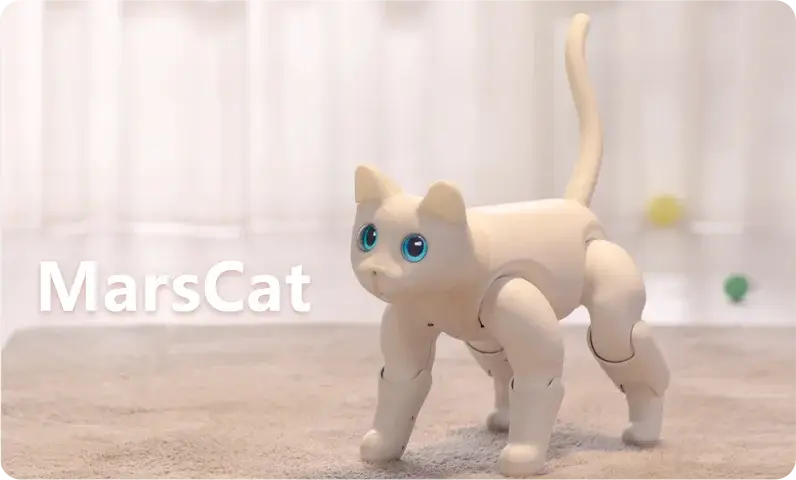
The motion question is a mismatch detector. Most desktop companions don’t walk, and vendors rarely volunteer that. If “can it move” matters to you, you are shopping in a different sub-category than most of this list serves, so check robot-style products rather than plush ones in our brand database.
CyberPals Take #2 — Which current products actually answer these
On the conversation filter, know which side of the line you’re buying. Ropet answers question #1 with a deliberate no: it’s a non-verbal emotional-presence specialist, and its owner community loves it for that. If you want the answer to be yes, Fuzozo attempts real conversation, and Eilik and Eiliko sit in between with reactive personality and limited speech, a trade-off we mapped in our Eilik vs Eiliko comparison. None of these is wrong; buying one while expecting another is.
On battery, washability, and shipping, demand specifics. Our Ropet review collects the owner-reported answers for that product; for anything newer, the honest answer is often “the community doesn’t know yet,” which is itself useful information. A product that can’t answer question #15 (“when does it ship?”) with a date is a crowdfunding bet, not a purchase. Readers buying Ropet through our link can use coupon code HOYHO for $8 off, and per our disclosure above, that link earns us a commission either way.
CyberPals Take #3 — Who should carry which questions
Sarah, 38: buying for a child
Your non-negotiables are #5, #6, #7, and #19. Ask what the toy records, where audio goes, which model answers your kid, and what the subscription costs at year two. Walk away from any booth (physical or online) that answers “it’s very safe” without specifics.
Maya, 27: buying for yourself
Your list is #1, #17, and #18. Decide up front whether you want a conversation partner or an emotional-presence pet, then check the collectible economics: limited editions and accessory lines are where this category quietly gets expensive.
Marcus, 34: still deciding
Start with #3 and #12 to calibrate expectations, then read one deep comparison (our Ropet vs Fuzozo piece is built exactly for this) before you let question #18 (“so cute!”) make the decision for you.
FAQ
What should I ask before buying an AI companion toy? Lead with five: Can it hold a real conversation? Does it work without internet? Are there subscription fees? Is it washable or serviceable? And what happens to its features if the maker shuts down its servers? Those five expose more products than the other fifteen combined.
Do AI plush toys require a subscription? Increasingly, the richest features do. Base functions usually work out of the box, but personality development, expanded conversation, and content libraries often sit behind app tiers. Always ask what the toy does at zero dollars a month.
Why do trade-show questions matter to buyers? Because they’re unfiltered demand data. Booth visitors ask what marketing copy doesn’t answer (battery, fees, washability, shipping), and that gap between the pitch and the questions is exactly where buyer regret lives.
CyberPals tracks 90+ companion products in our public brand database. We translate and contextualize industry reporting from the category’s home market so English-language buyers can see what owners see. We were not at MWC or AWE 2026 ourselves; all floor quotes above are translated from AI Toy Lab’s first-hand field notes.