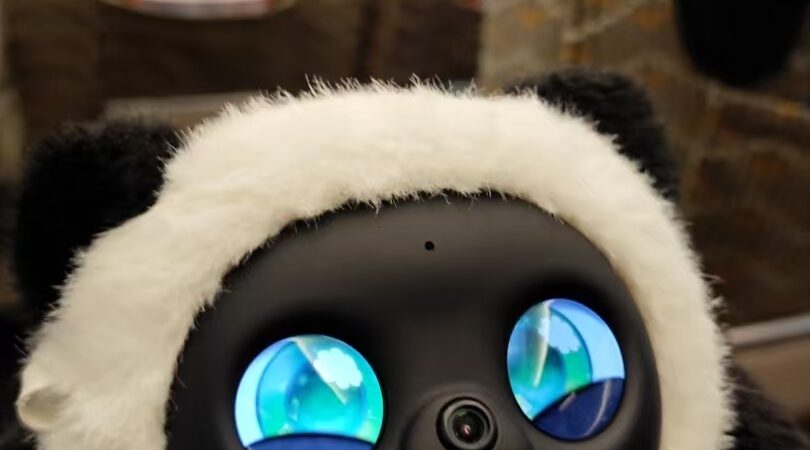
Short answer: the desktop companion robots we cover are a much smaller privacy risk than the AI chatbot toys that made headlines in late 2025, but they are not all the same risk. What determines safety is not the fur or the marketing. It is three questions: what sensors does the device carry, where does the data go, and who is it actually for? Eilik at $139.99 is the lowest-risk pick in our coverage because the base robot has no Wi-Fi, no app and no account; there is simply no pipe for data to leave through. Ropet carries a camera and pairs with a cloud account, but it is also the only pet in our coverage whose privacy policy we have now read line by line, and it includes a working path to delete your data. And the viral horror stories you saw in November 2025 were about a different kind of product: cheap plush toys wired to adult chatbot models and marketed at small children. We will keep those categories separate, because the safety answer is different for each.
Disclosure: CyberPals participates in the Ropet and Energize Lab (Eilik) affiliate programs, and purchases made through those links may earn us a commission. No other brand on this page has any commercial relationship with us, and our affiliate status never changes what we report. We have not conducted hands-on security testing of these devices; everything below comes from published policies, store documentation, owner reports and primary-source investigations, each cited where used.
Why this question got loud in late 2025
In November 2025, the U.S. PIRG Education Fund published its annual Trouble in Toyland report, and its AI toy findings were ugly. Researchers found that Kumma, a $99 teddy bear from FoloToy running on OpenAI’s GPT-4o, would tell a child where to find knives, explain how to light a match, and drift into sexually explicit territory. The fallout was fast: FoloToy suspended sales of its entire product line for a safety audit, and OpenAI confirmed it had cut off the developer’s access for policy violations. PIRG later retested the bear and reported the worst behavior was patched, which is better than nothing and also not a system you would want to rely on.
That same week, the child-advocacy group Fairplay issued a first-of-its-kind advisory, signed by over 150 children’s safety organizations and experts, urging parents not to buy AI toys for children at all. Their argument, as NPR’s coverage summarized it, is that these toys run on the same large language models that already have documented problems with minors, wrapped in a trust-inducing plush body.
Here is the distinction that got lost in the coverage: those warnings target open-ended chatbot toys marketed at kids as young as two. The products CyberPals reviews are mostly a different animal, desktop companions bought by adults for their own desks. Some of them cannot talk at all, by design. That difference is the whole safety story, so let’s map it.

The sensor map: what each device can see, hear and send
A privacy risk needs two things: a sensor to collect something, and a connection to send it somewhere. Marketing copy hides both. Store pages and policy documents reveal them. Here is the field as we have verified it, with store documentation current as of October 4, 2026.
| Device | Camera | Voice / microphone | Needs app + account | Network connection |
|---|---|---|---|---|
| Eilik ($139.99) | No | No conversation out of the box | No app, no account | None. No Wi-Fi hardware path to pair |
| Eilik + AI Station ($238.99) | No | Yes, via the $99 dock | Dock adds connectivity | Required for cloud conversation |
| Eiliko ($59.90) | No | No conversation | No app, no account | None |
| Ropet KAMOMO ($299) | Yes, computer vision | Reacts to sound; does not hold conversations | App + account for full features | Wi-Fi via app pairing |
Eilik and Eiliko details are from the official Energize Lab store, which states the robots work out of the box with no Wi-Fi, no app pairing and no account. Ropet’s computer vision is documented in owner reports we logged in our Ropet review, where one owner’s unit visually identified another robot in the room. We have not torn down either device; this table reflects documented behavior, not a hardware audit.
The pattern to notice: in this category, the privacy surface is a choice you make at checkout. Buy a base Eilik and there is nothing to secure. Add the AI Station dock and you have added a microphone and a cloud connection, at which point the sensible move is to treat it the way you would treat any smart speaker: keep it out of rooms where you discuss things you would not say in front of one. Buy a Ropet and you have brought a camera home, which is exactly why we went and read its privacy policy.
We read Ropet’s privacy policy so you don’t have to
When we published our Ropet review earlier this year, we flagged that its data practices had not been publicly reviewed. We have now read the current policy, last updated June 20, 2025, in full. The honest summary: it is a more serious document than we expected from a young company, with a few clauses you should know about before buying.
What we liked:
- Photos are opt-in, explicitly. The policy states that Ropet “does not automatically collect your photos or videos without your consent and affirmative action.” Camera features like Live Photos require you to turn them on.
- Your Wi-Fi password stays home. The policy commits that your Wi-Fi password “is only stored locally on your robot device and the App, and is not uploaded to ropet’s cloud servers.”
- There is a real deletion path. A “Device Authorization Revocation” setting in the app deletes device data from cloud servers, and a factory reset wipes what is stored locally. A documented two-step wipe is more than many smart-home brands offer.
- A no-sale commitment. Under the California section, the policy states that Ropet “does not sell your Personal Data to third parties,” with the standard caveat that advertising cookies on its website may count as a “sale” under California law.
What you should weigh on the other side:
- The app wants real data. Full functionality requires a Ropet account and Wi-Fi pairing, and the policy lists device identifiers and network information among what is collected. The pet works best as a connected product; that is the trade.
- Data can cross borders. The policy says information “may be stored, transferred to, and processed in” other countries where the company has facilities, with GDPR safeguards cited for European users. If data residency is a hard line for you, this is the clause to sit with.
- It is officially not for kids. The policy states the services “are not intended for children under 16.” That matches our read of the product, which is designed for adult collectors, and it matters if you were considering one as a child’s gift.
None of this is a red flag by the standards of connected devices. It is roughly the posture of a mainstream smart-home product, attached to something much cuter. Our HOYHO code still takes $8 off if you decide the camera is worth it.
The five-minute privacy check before you buy any AI companion
Brands change policies, and new devices arrive monthly. Rather than trusting any single review, including ours, run this check on whatever you are considering:
- Find the sensor list. Search the product page and FAQ for “camera,” “microphone” and “voice.” If you cannot determine what sensors a device has from official materials, treat that silence as the answer.
- Find the privacy policy and check the date. A connected device with no policy, or one that only covers website cookies, is a device whose data practices are undefined. Ropet’s is dated and product-specific; that should be the minimum bar.
- Look for a deletion path. Search the policy for “delete” and “retention.” You want a user-reachable control, not a support email address.
- Check the age posture. If the maker says 16+, believe it. If a toy is marketed to young children with open-ended AI chat, the FTC’s children’s privacy rules impose specific obligations, and PIRG’s testing shows how often guardrails fail in practice.
- Decide what the device earns. Offline devices like the base Eilik earn a desk anywhere. A camera-equipped pet earns the living room shelf, maybe not the bedroom. A cloud microphone earns smart-speaker rules.
So which should the privacy-conscious buyer pick?
If you want zero data exposure, buy the base Eilik. At $139.99 from the official store, it is the only option here whose privacy audit takes one sentence: it does not connect to anything. You give up conversation, which the field mostly fakes anyway. Skip the AI Station unless talking matters more to you than the microphone it brings.
If you want the pet experience and can live with smart-home rules, Ropet is a reasonable deal, with a readable policy and a real delete button. Know that the camera is the price of the magic; its vision features are a genuine part of the charm, as the owner reports in our review describe.
If you were shopping for a young child, this is not the category. That is not our hedge, it is the makers’ own fine print and the unanimous position of PIRG and Fairplay this season. For adults and teens, check our under-$300 field guide for what the same money buys.
Buyer worries, answered
Q: Can Ropet’s camera record me without my knowledge? A: The policy commits that photos and videos require “your consent and affirmative action,” and camera features are opt-in in the app. We have not independently verified firmware behavior, so we hold this where we hold every manufacturer claim: documented, not proven. Owners who want certainty can simply not enable photo features.
Q: Does Eilik send anything to the cloud? A: The base robot has no Wi-Fi pairing, no app and no account, per the official store’s own documentation. There is no connection to send data over. The $99 AI Station dock changes that by adding cloud conversation; that is a different, connected product and worth judging separately.
Q: Are these toys subject to children’s privacy law? A: The devices we cover position themselves as 16+ or adult products, which keeps them outside COPPA’s core scope. Toys that target under-13 users with data collection trigger COPPA obligations, which is part of why the kids’ AI toy segment is drawing regulatory heat.
Q: Did the Kumma incident affect the products you review? A: Not directly. Kumma is an open-ended chatbot toy for children; none of the devices in our coverage run unrestricted LLM chat aimed at kids. The incident matters because it reset the baseline question every buyer should ask: what model is talking to whom, and who tested it?
Sources and verification
Ropet’s privacy policy was retrieved from ropetai.com on October 19, 2026 (version dated June 20, 2025), and all quoted language is verbatim. Eilik, Eiliko and AI Station details reflect the official Energize Lab store as of October 4, 2026. The Kumma findings, FoloToy sales suspension, OpenAI developer suspension and retest results are from U.S. PIRG Education Fund publications (November and December 2025). The advisory against AI toys for children is from Fairplay, November 20, 2025, with coverage by NPR and the Associated Press. Ropet’s computer vision behavior is sourced from owner reports logged in our April 2026 review. We have not performed hands-on security testing; where a claim rests on a manufacturer’s policy rather than independent verification, we say so in place.